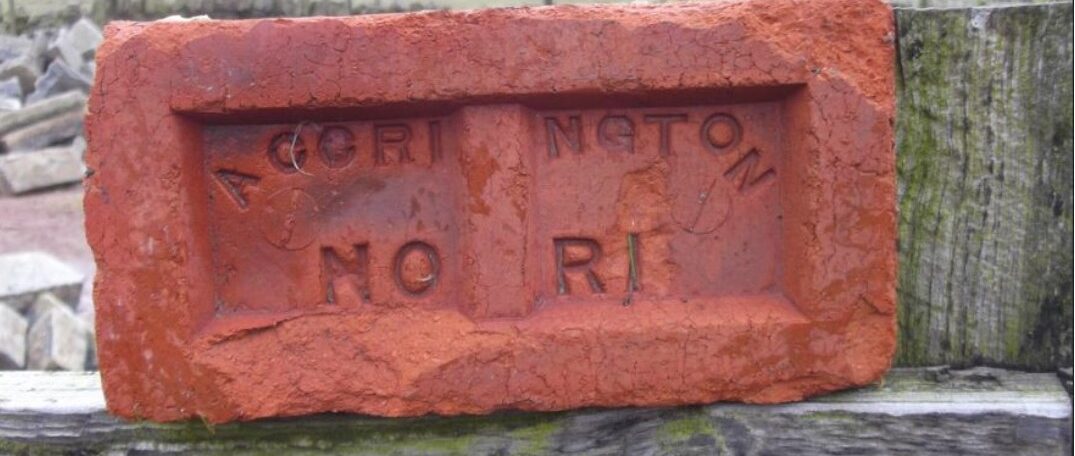
Guest speaker, Graham Topping, opened with a confession that he suffered from ‘Brickophilia’, a highly addictive condition that manifests itself in 3 stages:
Spotting individual bricks;
Scratching the surface of bricks to ascertain their colour and any inscription;
Collecting bricks (some collections run into the thousands).
Hyndburn has a long history of brickmaking, whose heritage value has only recently – belatedly – been recognised by the local council. The height of the industry came at the turn of the 20th Century when there were 16 brickyards in Hyndburn. By 1940, there was one: the Accrington Brick & Tile Company, whose trademark, NORI, was adopted, when the IRON brickworks in Chesterfield threatened to sue the Accrington Company for breach of copyright. The solution was to reverse the trademark.
Graham showed a diagram of the anatomy of a brick and explained that brickmakers had their trademark incorporated into each brick they produced. It is possible to date a brick from the style or wording on a brick. The oldest in his collection of 200 bricks dates from 1774, while one has 77 letters moulded into the ‘frog’.
Historically, bricks were made using the ‘slop’ system. ‘Pugging’ gangs extracted the mudstone from the quarry. The mudstone was mixed with water to form slop, the consistency of porridge, which was then poured into a mould before a steam press stamped the trademark into the mould and reduced the water content to less than 20%. (The Hyndburn mudstone was 7% iron, which gave NORI bricks their famous red colour. Other brickmakers had to add iron to their slop.) ‘Lumpers’ loaded up to 20 000 bricks into each kiln for firing. At its Huncoat site the Accrington Brick & Tile Company had 80 kilns: 25 being loaded; 25 firing; 25 cooling, with 5 spare. In its heyday the company produced 2 million NORI bricks per month.
The Company had a large design department – designing and producing the brick mould was a highly specialised and skilled job. Different applications e.g. houses, factories and, especially, chimneys required a variety of shapes and sizes of brick. The brick designers would give customers highly detailed designs of each build, along with an inventory of the designs and quantity of each brick needed. Thus, the customer had an accurate estimate of the cost.
The Huncoat site was closed in 1984, but there is still a brick-making facility in the area. It produces heritage bricks from mudstone quarried in NE England. The bricks are used in restoration work for buildings originally constructed with NORI brick, including the Winter Gardens in Blackpool. As was always the case in the past, the modern factory also produces decorative tiles that have been used to restore the Thwaites Brewery Mural, when it was moved from the Blackburn factory to the new brewery at Salmesbury.
Pete Booth thanked Graham for his most illuminating and amusing talk. Despite the fact that we are surrounded by thousands of brick structures, we rarely, if ever, consider the processes or the lives of the local people involved in their manufacture.
We are looking forward to hearing Part 2 of the story in February.