A History of the Hand, Dandy and Power Loom Makers in Trawden and Colne
1819-2005
Anthony Pilling
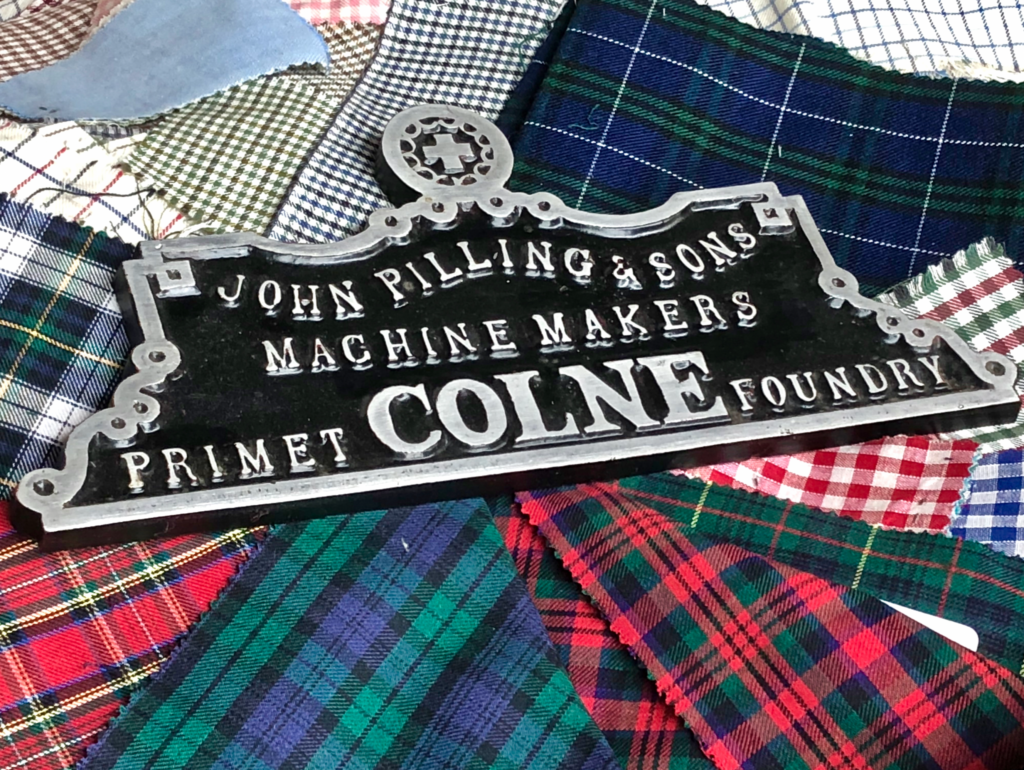
John Pilling and Sons, a company of loom makers, textile machinists and millwrights, was established in Trawden in 1819, when handloom weavers produced cloth in their own homes. Anthony explained how he had helped restore – then weave cloth on – an 18th century domestic loom used to weave a twill pattern for Napoleonic war uniforms and cloaks. At this time such basic looms were the norm with the width of the cloth limited to the operative’s reach (about 40 inches).
This branch of Pillings lived at Alderhurst End and nearby Seghole (Stag Hall), Trawden, where Anthony’s great grandfather was born. Seghole had been built to oversee the stag hunting ground between two vaccaries. Around 1740 the building was rebuilt as a loom shop house, both were handloom farms first weaving wool and later cotton. From the Duke of Buccleuch’s lease schedule there was also a water powered mill immediately below Seg Hole by the river at Midge Hole.
Instrumental to the establishment of John Pilling’s operation was William Wilkinson of Further Wanless Farm. Wilkinson was a ‘clothier’ who oversaw a ‘production line’ of domestic cotton spinners and weavers. He used packhorses and carts to ‘put out’ prepared warp and weft to the weavers and collect finished cloth pieces, which he would transport to the Cloth Hall for sale. After 1819, Wilkinson commissioned John Pilling to make ‘dandy’ handlooms for domestic weavers. The 1844 OS map shows that John Pilling’s 1819 workshop was at Lane House next to Slack Booth Barn. First developed at the beginning of the !9th century, dandy looms incorporated a number of technical improvements that increased productivity, along with the width and quality of cloth.
The earliest power looms date from the late 18th century but were not effective at first and despite frequent improvements in design and operation, the majority of cloth was woven on handlooms until well into the 19th century. By the time of the 1844 Trawden Tithe map, John Pilling’s business had expanded into a Mechanic’s Shop behind Lane House Cotton Mill which wove on 100 timber framed wiper power looms that John Pilling had made around 1830, with power from the mill’s engine and boiler house.
Metal looms were patented by Roberts in Manchester and improved throughout the 1820s and 30s, so in 1849 John Pilling & Sons moved to larger machine shops he built in Colne to be next to the new railway. Improvements in the design and operation of looms meant that spinning and weaving became increasingly factory based – a step change in production. By the time of the 1851 Great Exhibition at Crystal Palace, the ‘Lancashire Loom’ was firmly established, and one operative could oversee 4, 6 or even 8 looms.
Throughout his talk, Anthony displayed an encyclopaedic knowledge of spinning and weaving processes, illustrated with detailed, informative slides that emphasised the increasing complexity of machinery used as industrialisation of the cotton trade progressed. Anthony donated his fee for the talk to The Grane Engineering Museum, Laneside Road, Haslingden, Rossendale, BB4 6PG.